
Home / Articles / In-Line vs. End-of-Line Flame Arresters: Types and Applications
TANK SAFETY · TECHNICAL GUIDE
In-Line vs. End-of-Line Flame Arresters: Types and Applications
The installation location is one of the first decisions in flame arrester selection. This guide explains the general difference between in-line and end-of-line arrangements and why the actual flame scenario matters.
1. What does “end-of-line” mean?
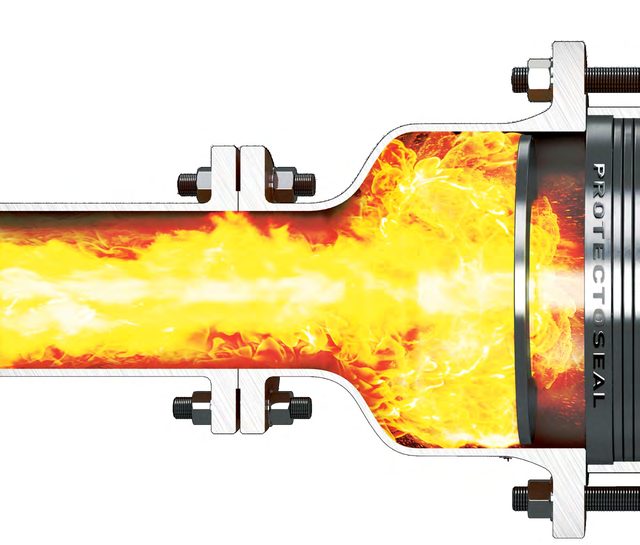
An end-of-line flame arrester is installed at the end of a vent or pipe, often where a tank or process system communicates with the atmosphere. Some designs are intended to stop an external flame from entering the protected system. Venting duty, weather exposure, drainage, orientation and access for inspection must be reviewed against the specific model instructions.
2. What does “in-line” mean?
An in-line flame arrester is installed within a pipe run. Depending on its design and rating, it may protect connected equipment against a defined flame-propagation scenario. Pipe length, diameter, bends, valves, obstructions and the location of potential ignition sources can affect flame behaviour, so an in-line unit must be selected for the actual system geometry.
3. Deflagration and detonation are not interchangeable
A deflagration flame propagates subsonically relative to the unburned gas, while a detonation involves a coupled shock wave and reaction front. Devices designed for one duty must not be assumed suitable for the other. The possible flame acceleration and pressure loads must be assessed by qualified process-safety personnel and matched to manufacturer-tested applications.
4. A practical comparison
End-of-line arrangements are commonly associated with vessel vents and atmospheric interfaces; in-line arrangements are installed inside piping. These are broad descriptions, not universal rules. The required device depends on the hazard assessment, gas or vapour properties, operating conditions and the manufacturer’s tested limitations.
5. Information to confirm before specifying
Document the protected equipment, potential ignition location, gas composition, operating and design pressure and temperature, pipe dimensions and layout, expected flow and pressure drop, environmental conditions, maintenance access and any applicable standards or project requirements. Ask the manufacturer to confirm suitability for the specific scenario and installation.
6. Conclusion
Do not choose a flame arrester solely by connection size or the words “in-line” and “end-of-line.” Confirm the credible flame scenario and the exact device’s tested duty, installation limits and maintenance requirements. Final selection should follow the process hazard assessment and current manufacturer documentation.
Discuss your application with WNP
Share your technical specification with WNP to discuss the required product configuration and request current manufacturer documentation.
Technical note: Technical note: This article is introductory and is not a substitute for a process hazard assessment, approved project specification or current manufacturer documentation. Confirm all ratings, materials, standards and product-specific claims for the exact configuration.